



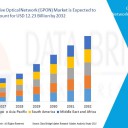
The Gigabit Passive Optical Network (GPON) market has emerged as a cornerstone of modern broadband infrastructure, enabling ultra-fast, reliable, and scalable connectivity across residential, commercial, and industrial applications. As global demand for high-speed internet continues to surge, driven by digital transformation, cloud computing, video streaming, and smart technologies, GPON has positioned itself as a preferred fiber access technology worldwide.
Understanding GPON Technology
GPON is a point-to-multipoint fiber access technology that delivers gigabit-level speeds using passive optical splitters. Unlike traditional copper-based networks, GPON uses optical fiber to transmit data over long distances with minimal signal loss. A single optical fiber from the service provider’s central office can serve multiple end users, making it both cost-effective and efficient.
GPON typically supports downstream speeds of up to 2.5 Gbps and upstream speeds of up to 1.25 Gbps. Its passive architecture eliminates the need for powered equipment between the central office and end users, reducing operational complexity and maintenance costs.
Market Growth Drivers
One of the primary drivers of the GPON market is the exponential growth in data consumption. High-definition and ultra-high-definition video streaming, online gaming, remote working, and virtual collaboration tools demand robust and low-latency networks. GPON meets these requirements by offering high bandwidth and stable performance.
The rapid expansion of fiber-to-the-home (FTTH) and fiber-to-the-building (FTTB) deployments is another significant growth factor. Governments and telecom operators across the globe are investing heavily in fiber infrastructure to bridge the digital divide and improve internet penetration in urban and rural areas alike.
Additionally, the rise of smart cities and Internet of Things (IoT) applications has increased the need for dependable and high-capacity networks. GPON supports large-scale connectivity, making it suitable for smart surveillance systems, intelligent transportation, and connected utilities.
Role of GPON in Telecommunications
Telecom operators are increasingly adopting GPON to upgrade legacy networks and enhance service offerings. Compared to Digital Subscriber Line (DSL) and cable-based systems, GPON provides superior speed, reliability, and future scalability. It enables operators to deliver bundled services such as high-speed internet, IPTV, and voice over IP (VoIP) over a single fiber connection.
GPON also supports quality of service (QoS) mechanisms, ensuring seamless delivery of bandwidth-intensive and latency-sensitive applications. This capability is particularly important as consumers expect uninterrupted connectivity and consistent performance.
Enterprise and Commercial Applications
Beyond residential use, GPON is gaining traction in enterprise and commercial environments. Large office complexes, campuses, hotels, airports, and hospitals are deploying GPON networks to simplify infrastructure and reduce cabling costs. A single GPON network can replace multiple legacy networks, streamlining management and improving operational efficiency.
In sectors such as healthcare and education, GPON enables high-speed data transfer, telemedicine services, virtual classrooms, and centralized network management. These advantages make GPON an attractive solution for organizations undergoing digital transformation.
Regional Market Dynamics
The GPON market demonstrates strong growth across multiple regions. Asia-Pacific leads the market due to large-scale fiber deployments in countries such as China, Japan, and South Korea. Rapid urbanization, growing internet user bases, and government-led broadband initiatives contribute significantly to regional expansion.
North America and Europe also represent mature and steadily growing markets. In these regions, the focus is on upgrading existing infrastructure to support higher bandwidth demands and next-generation services. Meanwhile, emerging economies in Latin America, the Middle East, and Africa are increasingly adopting GPON to improve connectivity and support economic development.
Competitive Landscape and Innovation
The GPON market is characterized by continuous technological innovation and competitive dynamics. Network equipment manufacturers and solution providers are focusing on improving performance, reducing deployment costs, and enhancing compatibility with next-generation technologies.
Integration with advanced solutions such as software-defined networking (SDN) and network function virtualization (NFV) is gaining momentum. These technologies allow service providers to manage GPON networks more flexibly and efficiently, supporting dynamic bandwidth allocation and rapid service provisioning.
Moreover, the evolution toward 10G PON and next-generation PON standards is influencing market strategies. While GPON remains widely deployed, many operators are adopting a coexistence approach, enabling a smooth transition to higher-speed technologies without disrupting existing services.
Challenges and Limitations
Despite its advantages, the GPON market faces certain challenges. High initial deployment costs, particularly in regions with limited infrastructure, can act as a barrier. Fiber installation requires significant investment in civil works, planning, and skilled labor.
Interoperability and standardization issues may also arise, especially when integrating equipment from multiple vendors. However, ongoing standardization efforts and improved compatibility are helping mitigate these concerns.
Another challenge is the increasing demand for even higher speeds, driven by emerging applications such as augmented reality, virtual reality, and advanced cloud services. While GPON meets current requirements, operators must plan for future upgrades to remain competitive.
Impact of Digital Transformation
Digital transformation across industries is accelerating the adoption of GPON networks. Cloud-based services, remote operations, and data-driven decision-making rely heavily on high-speed and low-latency connectivity. GPON provides a reliable foundation for these digital initiatives, enabling seamless access to data and applications.
The shift toward remote work and hybrid work models has further emphasized the need for robust broadband infrastructure. Households now require enterprise-grade connectivity to support multiple users, devices, and applications simultaneously, reinforcing GPON’s relevance in the modern digital ecosystem.
Future Outlook
The future of the GPON market appears promising, supported by sustained investments in fiber infrastructure and rising connectivity demands. As consumers and businesses continue to rely on digital services, the need for scalable and high-performance networks will remain strong.
GPON is expected to coexist with next-generation PON technologies, serving as a foundational layer for broadband access. Its proven reliability, cost efficiency, and widespread adoption ensure its continued role in global connectivity expansion.
In the long term, advancements in optical networking, combined with smart network management solutions, will further enhance GPON capabilities. This evolution will enable service providers to deliver faster, more reliable, and more flexible services, reinforcing GPON’s position as a critical enabler of the digital economy.
Conclusion
The Gigabit Passive Optical Network market plays a vital role in shaping the future of broadband connectivity. By offering high-speed, scalable, and cost-effective fiber access, GPON addresses the growing demands of modern digital lifestyles and business operations. Despite challenges related to deployment costs and evolving bandwidth needs, its benefits far outweigh the limitations. As global digitalization continues to accelerate, GPON will remain a key technology driving connectivity, innovation, and economic growth worldwide.
Neuste Artikel
- Medical Nonwoven Market Expands Rapidly Driven by Infection Control and Healthcare Demand (
 rrdbmr)
 - https://loc.edu/wp-content/uploads/event-manager-uploads/event_banner/2026/01/eleventwelve.pdf (
 fefdfg)
 - https://loc.edu/wp-content/uploads/event-manager-uploads/event_banner/2026/01/newtodayeightteen.pdf ( fefdfg)
- Luxury Candle Market Illuminates Growth with Rising Demand for Premium Home Fragrances ( rrdbmr)
- https://docs.google.com/document/d/1ZRQOVnbOSlprRoZBrTUoztpW9ANNae8mVchDWSyP2RY/ (
 wazuvosy)
 - https://docs.google.com/document/d/15kYF28heWAGoRbOLWOu9aCfsXZthig4bA540Cx-t61s/ ( wazuvosy)
Die neuesten Forenbeiträge
Werbung